

Franklin Kim
Associate Professor
ShanghaiTech University
School of Physical Science and Technology
Email: fkim@shanghaitech.edu.cn
Phone: +86-21-2068-5245
Office: SPST 2-506C
ORCID: 0000-0002-6548-6588
Professional Experience
| 2017–present | ShanghaiTech University, Associate Professor School of Physical Science and Technology (SPST) |
| 2011–2017 | Kyoto University, Assistant/Associate Professor Institute for Integrated Cell-Material Sciences (iCeMS) |
| 2007–2010 | Northwestern University, Postdoctoral Researcher Department of Materials Science and Engineering (Prof. Jiaxing Huang) |
| 2005–2007 | University of California, Berkeley, Postdoctoral Researcher Department of Bioengineering (Prof. Luke P. Lee) |
Educational Background
| 1999–2005 | University of California, Berkeley, Ph.D. in Chemistry (Advisor: Prof. Peidong Yang) |
| 1996–1999 | Seoul National University, B.S. in Chemistry |
Research
Gas-Informed Operando Diagnostics and Data Science for Reliable Energy Devices
Rechargeable batteries power technologies from consumer electronics to EVs and the grid, yet capacity fade, rising impedance, and thermal risks continue to limit lifetime and safety. Many critical degradation processes are accompanied by gas evolution, making gas signals a sensitive and chemically informative window into battery health.
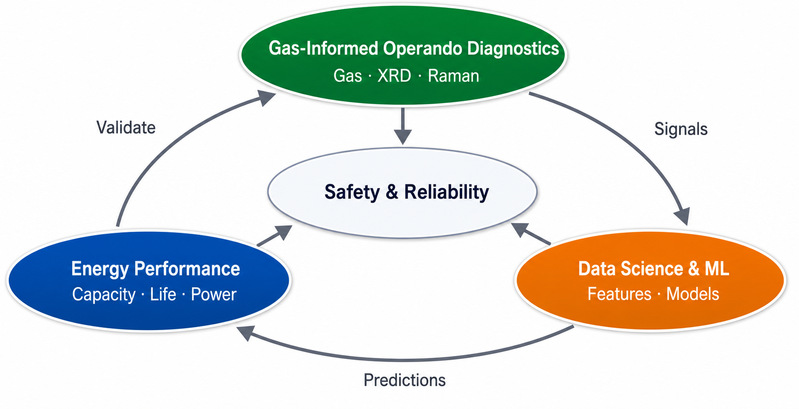
Our group develops gas-informed battery diagnostics by combining online electrochemical mass spectrometry (OEMS), in situ/operando XRD and Raman spectroscopy, electrochemical testing, and data science. Gas signals provide early indicators of electrolyte decomposition, interfacial instability, and degradation-stage transitions. Correlative structural and chemical measurements help connect these signals to physical mechanisms, while machine learning converts complex diagnostic data into interpretable models for stage detection and long-horizon forecasting. Predictions are validated against energy performance metrics such as capacity, life, and power, closing the loop toward safer and more reliable energy devices.
1. Gas-informed operando diagnosis of battery degradation
We use OEMS to acquire cycle-resolved gas evolution under realistic operating conditions. Gases such as CO, CO2, C2H4, and related species provide early signatures of electrolyte decomposition, interfacial side reactions, and degradation-stage transitions. By linking gas evolution with electrochemical response, we aim to identify warning signs before severe capacity loss or safety-relevant failure occurs.
2. Data science and machine learning for detection and forecasting
We build compact, reproducible pipelines that map gas, structural, and electrochemical signals to battery state and future behavior. Emphasis is placed on chemically meaningful features, interpretability, robustness with limited data, and portability across test conditions. When appropriate, we use unsupervised stage classification and single- or few-shot forecasting to detect degradation stages and predict long-term performance from early-cycle information.
3. Energy-performance validation and materials strategies
We validate model predictions against capacity, life, and power metrics, then use the insights to guide materials design, interface engineering, and operating protocols for longer-lived cells. In parallel, we develop interfacial assembly methods for nanomaterials, including Langmuir–Blodgett and diffusion-driven layer-by-layer processes, to fabricate ultrathin and multilayer films with controlled transport and stability. These materials strategies support the broader goal of improving safety and reliability in energy devices.
Latest Highlights
2026.06 — The paper by Yu Yue, 'Open-Loop, Barrier-Free, Continuous Langmuir–Blodgett-Based Multipass Multilayer Deposition,” was accepted by Langmuir.
2026.04 — The paper by Yiqing Lu and Jianli Zou, “Gas-Informed Machine Learning Framework for Stage Classification and Early Forecasting of Battery Degradation,” was accepted by ACS Applied Materials & Interfaces.
2026.03 — Our project, “Field-Deployable Lithium-Ion Battery Pressure Monitoring and Health Prediction System,” was selected for support by the ShanghaiTech AI Innovation Program (AI4S).
Chinese title: 面向现场可部署的锂电池压力监测与健康预测系统研究
Publications
Selected recent publications
“Open-Loop, Barrier-Free, Continuous Langmuir–Blodgett-Based Multipass Multilayer Deposition.”Y. Yu, J. Zou, F. Kim. Langmuir 2026, just published. [link]
“Gas-Informed Machine Learning Framework for Stage Classification and Early Forecasting of Battery Degradation.”Y. Lu, J. Zou, L. Zhang, H. Wang, F. Kim. ACS Appl. Mater. Interfaces 2026, 18, 26311–26322. [link]
“The Resurging of Hydrocarbon Gas as Early Sign of Battery Rollover Degradation.”Z. Jiang, L. Zhang, Y. Yu, J. Zuo, F. Kim. ACS Appl. Mater. Interfaces 2025, 17, 4934. [link]
“Langmuir–Blodgett Assembly of Ti3C2Tx Nanosheets for Planar Microsupercapacitors.”L. Fan, P. Wen, X. Zhao, J. Zou, F. Kim. ACS Appl. Nano Mater. 2022, 5, 4170. [link]
“Revisiting the Structural Evolution of MoS2 during Alkali Metal (Li, Na, and K) Intercalation.”G. Wang, Y. Zhang, H. S. Cho, X. Zhao, F. Kim, J. Zou. ACS Appl. Energy Mater. 2021, 4, 14180. [link]
“MnCO3 on Graphene Porous Framework via Diffusion-Driven Layer-by-Layer Assembly for High-Performance Pseudocapacitor.”B. Zhang, X. Li, J. Zou, F. Kim. ACS Appl. Mater. Interfaces 2020, 12, 47695. [link]
“Adjusting Channel Size within PVA-Based Hydrogels via Ice Templating for Enhanced Solar Steam Generation.”F. Li, R. Zhu, P. Wen, X. Zhao, G. Wang, J. Zou, F. Kim. ACS Appl. Energy Mater. 2020, 3, 9216. [link]
Group Members
Current Members

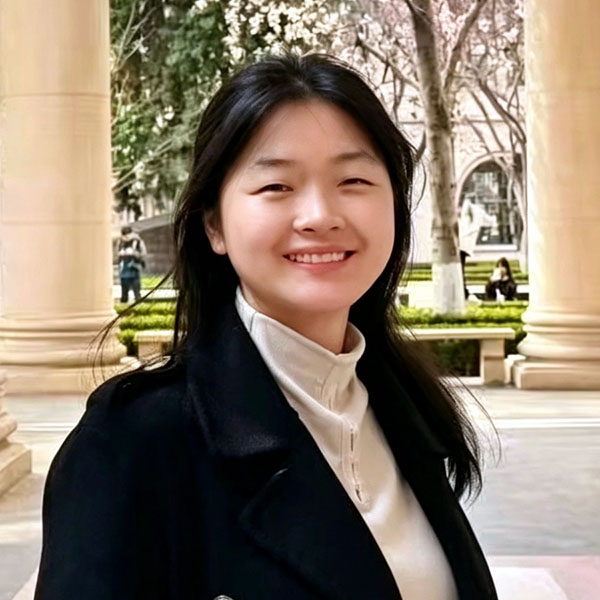
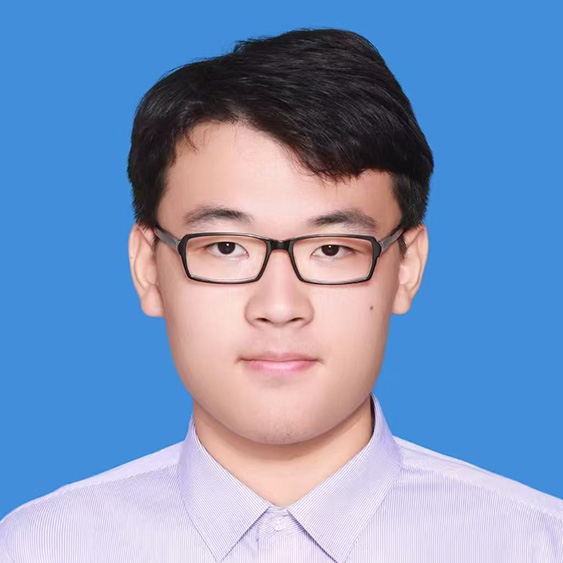
Alumni (ShanghaiTech University group)
| Yu Yue | Master (Sep. 2022 – Aug. 2026), Currently at MetaX (沐曦) as a Procurement Engineer |
| Zuofu Jiang | Master (Sep. 2022 – Aug. 2025) |
| Piao Wen | Ph.D. (Sep. 2017 – Jun. 2022) |
| Xiaowen Zhao | Ph.D. (Jan. 2018 – Jun. 2022) |
| Li Fan | Master (Sep. 2019 – Jun. 2022) |
| Gang Wang | Master (Jan. 2018 – Jan. 2022) |
| Xin Li | Master (Sep. 2017 – Sep. 2020), Currently at Zhejiang University |
| Xinyue Qu | Undergraduate (Sep. 2018 – Sep. 2020), Currently at Tsinghua-Berkeley Shenzhen Institute |
| Li Chuang | Master (Sep. 2017 – Sep. 2020), Currently at Tsinghua-Berkeley Shenzhen Institute |
| Runzhi Zhu | Undergraduate (Mar. 2018 – Jun. 2020) |
Alumni (Kyoto University group)
| Xiaodong Hong | Visiting Scholar (Sep. 2014 – Mar. 2015) |
| Daehwan Kim | Undergraduate Researcher (Jan. 2014 – Feb. 2015) |
| Jianli Zou | Postdoctoral Researcher (Sep. 2011 – Mar. 2015) |
| Elizabeth Murphy | Lab Technician (Aug. 2013 – Mar. 2015) |
| Kangmin Lee | Visiting Scholar (Jul. 2014 – Aug. 2014) |
| Haruna Kurasho | Undergraduate Researcher (Sep. 2013 – Mar. 2014) |
| Hyungcheol Chae | Undergraduate Researcher (Aug. 2012 – Mar. 2014) |
| Sanjib Bhattacharyya | Postdoctoral Researcher (Apr. 2013 – Mar. 2014) |
| Krishna Kattel | Postdoctoral Researcher (Mar. 2013 – Feb. 2014) |
| Lin Wang | Postdoctoral Researcher (Aug. 2011 – Dec. 2013) |
| Cao Qing | Visiting Graduate Student Researcher, Xiamen University |
| Jungwon Shin | Undergraduate Researcher |
| Jeesoo Park | Undergraduate Researcher |
Open Positions
We offer an international research environment focused on advanced materials characterization and fundamental understanding. To support researcher development, Prof. Kim provides guidance on applications for fellowships, competitive grants, and international visiting programs.
1. Graduate Student Researchers (M.S./Ph.D.)
We welcome prospective graduate students interested in energy storage, nanoscience, and data science. For students entering in 2026, the main recruitment focus is battery-related research, especially the development of gas-informed diagnostic methods for battery degradation analysis, health monitoring, and lifetime forecasting.
Possible project areas include battery gas diagnostics, OEMS-based degradation analysis, pressure/gas-sensing approaches for battery health monitoring, operando XRD/Raman characterization, data-driven electrochemistry, and machine-learning-assisted degradation forecasting.
Preferred backgrounds include chemistry, materials science, or chemical engineering. Experience in any of the following is a plus but not required: electrochemistry; materials characterization; gas analysis; data analysis or machine learning; and nanomaterials.
To inquire, please email a CV and a brief statement of research interests to fkim@shanghaitech.edu.cn. Official admission is through ShanghaiTech University graduate admissions.
2. Undergraduate Student Researchers
We invite undergraduates to gain hands-on research experience. Students typically begin by working with a graduate mentor and may transition to an independent project as training and interests develop.
To inquire, contact fkim@shanghaitech.edu.cn.